Understanding TDF: Why Accurate Performance Predictions Matter
When evaluating the performance of a vessel, one of the most important questions is also one of the simplest: How fast will it go? Answering that question requires a deep understanding of hull resistance, propulsion performance, and the complex interaction between the two. One factor that plays a key role in this process is the Thrust Deduction Factor (TDF).
What is TDF?
The Thrust Deduction Factor is used to account for the difference between a vessel’s measured hull resistance and the actual resistance experienced when a propulsion system is installed. Traditionally, hull resistance is calculated or measured using a “bare hull” configuration. This means the hull is analyzed without propulsion equipment or other appendages attached. Resistance data can be obtained through empirical calculations, CFD simulations, or physical model testing in towing tanks.
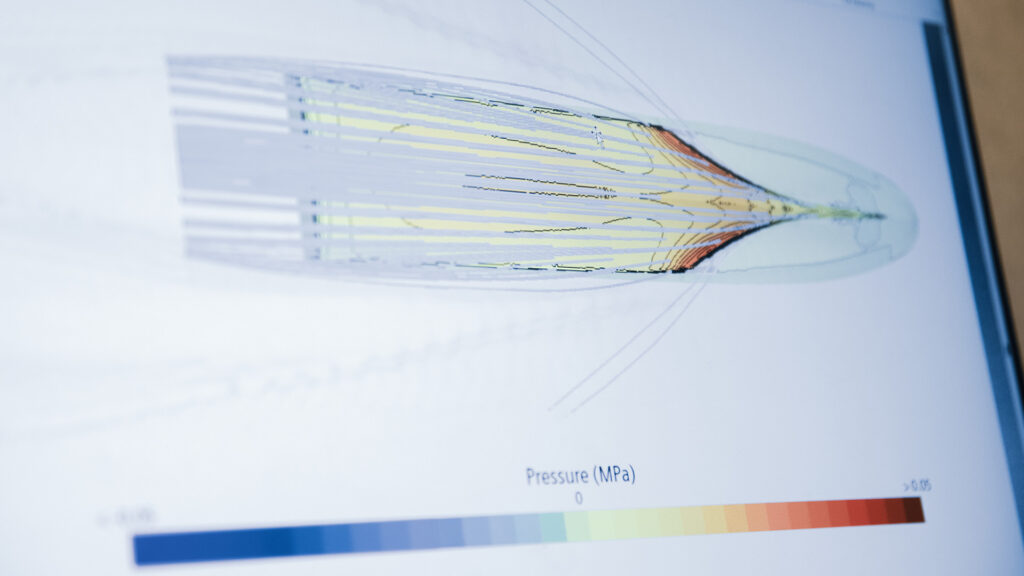
However, once a propulsion system is added, the flow around the hull changes. Propellers, waterjets, rudders, shaft brackets and other appendages all affect the pressure distribution around the vessel. As a result, the resistance experienced during operation differs from the resistance measured for the bare hull. TDF is used to compensate for this difference.
Why it matters
Accurate resistance predictions are essential when determining vessel performance. MJP use resistance data together with propulsion thrust curves to estimate a vessel’s achievable speed. The point where the available thrust equals the hull resistance determines the predicted top speed and operating performance.
If the resistance curve is inaccurate, the performance prediction will be inaccurate as well. Applying a TDF adjusts the resistance curve, either increasing or decreasing the predicted resistance, depending on how the propulsion system interacts with the hull.
Why a standard TDF value can be misleading
One of the biggest challenges with TDF is that it is highly dependent on the individual vessel. Hull shape, beam, displacement, operating speed, waterjet size, intake design and many other factors influence the actual value. Two vessels with similar dimensions may still require very different TDF corrections.
“TDF is not a universal constant. That’s why we prefer a conservative approach, unless we have project-specific data to validate the factor,” says Markus Norberg, Global Technical Sales Manager at MJP.
Applying a generic industry value can sometimes lead to overly optimistic performance predictions. For high-speed vessels in particular, an incorrectly applied TDF may artificially reduce the calculated resistance, resulting in speed estimates that are difficult to achieve in real-world operation.
MJP’s approach to TDF
At MJP, performance calculations are typically presented with TDF set to zero unless project-specific data is available. This approach is deliberate. By avoiding assumptions about a highly variable factor, MJP ensures that performance estimates remain conservative and realistic. Customers receive predictions based on known data rather than optimistic corrections that may or may not apply to their specific vessel.
The bottom line
TDF may be a relatively small parameter, but its impact on performance predictions can be significant. Ultimately, the goal is not to generate the highest performance figures on paper. It is to provide vessel builders and operators with realistic expectations based on sound engineering principles.
“It’s easy to make the numbers look good in theory. Our focus is on providing realistic performance estimates that customers can trust in real-world operation”, Markus finishes.