EVERYTHING YOU NEED TO KNOW. IN ONE PLACE.
FREQUENTLY ASKED QUESTIONS
FAQ
Choosing the right propulsion solution often raises questions – whether you’re designing, building, or operating a vessel. Below you’ll find clear answers to the most common topics our customers ask about, from waterjet technology and installation to performance, maintenance, and long-term support.
General Questions
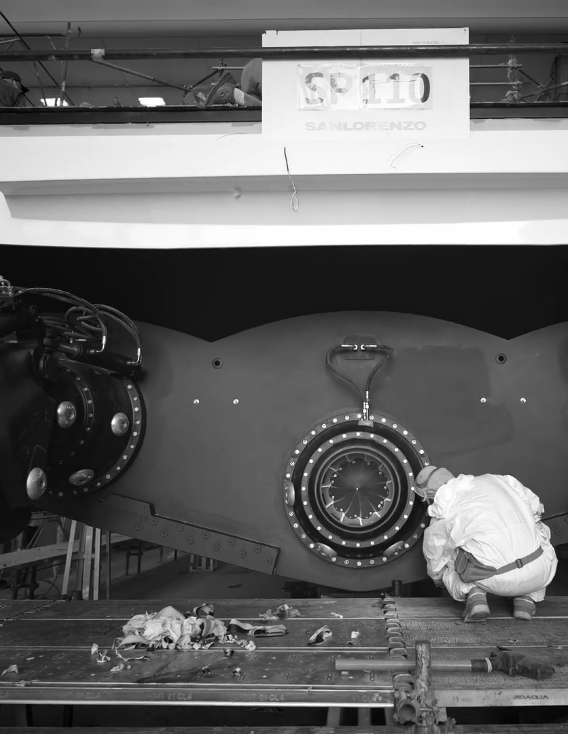
WHAT IS A WATERJET ON A BOAT?
A waterjet is a propulsion system that draws water in through an intake, accelerates it with an impeller, and expels it through a nozzle to create thrust. It replaces the need for a traditional propeller and offers safer, more responsive maneuvering.
HOW DOES A WATERJET PROPULSION SYSTEM WORK?
A waterjet works by pulling water in from beneath the hull, pressurizing it, and pushing it out at high speed. This generates forward motion while providing superior control, especially at high speeds or in shallow waters.
WHAT ARE THE ADVANTAGES OF WATERJET PROPULSION COMPARED TO PROPELLERS?
Waterjets offer greater maneuverability, reduced draft, improved safety, quick acceleration, and minimal vibration. They are also ideal for high-speed craft and vessels that operate near people or objects.
WHAT TYPES OF BOATS USE WATERJETS?
Waterjets are used in military craft, police and rescue vessels, ferries, pilot boats, crew transfer vessels, workboats, and leisure yachts. They are popular where speed, precision and safety are critical.
HOW DO I CHOOSE THE RIGHT WATERJET FOR MY VESSEL?
The correct system depends on vessel size, hull design, mission profile, engine setup, and desired performance. MJP provides engineering support and the Jet Selector Tool to match you with the ideal configuration.
WHAT DEFINES THE EFFICIENCY OF A WATERJET PROPULSION SYSTEM?
Efficiency must be evaluated at a system level, where the hull, inlet, pump, and outlet interact. With correct dimensioning and integration, a waterjet can maintain high efficiency across the full operating profile – not only at a single design point. This means efficiency is not determined by the jet unit alone, but by how the entire propulsion system performs in real operating conditions. MJP supports with more detailed analysis based on operational profile and performance criteria.
HOW IS THRUST GENERATED IN A WATERJET SYSTEM?
Thrust is generated by accelerating a controlled mass flow of water through the system. Net thrust depends on both the mass flow and the velocity increase achieved by the pump.
WHY CAN EARLY-STAGE PERFORMANCE ESTIMATES BE MISLEADING?
Incorrect assumptions in the early design stages can lead to overestimated performance. Reliable predictions require transparent methods and validation across the full operating profile. MJP uses validated CFD models and empirical data to ensure that performance predictions are realistic and reproducible.
HOW SHOULD PROPULSION SYSTEMS BE EVALUATED AND COMPARED?
Comparisons must consider methodology, assumptions, and validation approaches. Performance data should be reproducible in real-world operation and not based on optimistic or non-verifiable corrections. Differences in modeling assumptions, such as thrust deduction factors or inflow conditions, can significantly distort comparisons between suppliers. As example MJP applies TDF = 0 to eliminate uncertainty and ensure that all reported performance is conservative and verifiable.
WHY IS SYSTEM INTEGRATION CRITICAL FOR PERFORMANCE?
Performance is determined by how the full system is integrated. Hull interaction, inflow conditions, and installation directly influence thrust, efficiency, and cavitation behavior. MJP can through detailed analysis customize inlet to optimize the system for its purpose.
WHAT AFFECTS PROPULSION SYSTEM RELIABILITY?
Reliability depends on robust design, material selection, and correct integration. Systems designed for continuous operation with fewer exposed components reduce risk and improve long-term performance. MJP systems are engineered for demanding environments and supported throughout the vessel lifecycle.
WHAT ARE THE ADVANTAGES OF WATERJETS COMPARED TO IPS OR PROPELLERS?
Waterjets offer superior maneuverability, lower vibration, and reduced risk of external damage due to fewer exposed components. Compared to IPS and propellers, waterjets also provide faster response, improved safety in shallow or debris-filled waters, and greater operational flexibility.
WHAT CAUSES CAVITATION IN WATERJET SYSTEMS?
Cavitation is typically caused by poor inflow conditions, pressure losses, or incorrect system design. Variations in inlet flow, wake effects, or improper sizing can significantly increase cavitation risk and reduce efficiency. MJP minimizes cavitation risk through optimized inlet design, accurate CFD modelling, and validated empirical data. By ensuring high inflow quality and correct system integration, stable operating conditions can be maintained across the full performance range.
Questions From Design Houses
HOW DO WATERJETS IMPACT HULL DESIGN AND VESSEL HYDRODYNAMICS?
Waterjets require optimized hull geometry for intake flow, loading, and performance. Proper positioning improves efficiency, acceleration, and cavitation resistance.
WHAT DESIGN PARAMETERS ARE NEEDED TO SIZE A MARINE WATERJET SYSTEM?
Key inputs include displacement, resistance curves, engine power, operating profile, and required top speed. Our engineers support calculations during concept and pre-design phases.
CAN WATERJETS BE INTEGRATED INTO HYBRID OR ELECTRIC PROPULSION LAYOUTS?
Yes. MJP waterjets work seamlessly with diesel, hybrid, and fully electric drivetrains and support both direct and gearbox-driven configurations.
WHAT CAD OR TECHNICAL DATA DOES MJP PROVIDE TO DESIGN HOUSES?
We supply 3D models, interface documentation, intake drawings, weight tables, and installation guidelines to ensure accurate integration into vessel designs.
HOW DOES WATERJET SELECTION INFLUENCE STABILITY AND WEIGHT DISTRIBUTION?
Waterjets eliminate appendages and shift weight internally, improving stability and reducing drag. Proper placement balances longitudinal trim and enhances performance across speed ranges.
WHAT IS THRUST DEDUCTION FACTOR (TDF), AND WHY DOES IT MATTER?
TDF describes how propulsion affects hull resistance. Using non-verifiable correction factors can distort results, while a conservative approach ensures reproducible performance data. MJP applies TDF = 0 to eliminate uncertainty and ensure that all reported performance is conservative and verifiable.
HOW DOES INFLOW AFFECT PERFORMANCE?
Inflow conditions, including wake effects and wake fraction, determine the pump’s operating point. Variations can significantly influence efficiency and cavitation.
WHY IS THE CORRECT SYSTEM SIZING CRITICAL?
Power, speed profile, and hull characteristics must be analyzed together. Incorrect sizing leads to reduced efficiency and suboptimal real-world performance.
WHY CAN EARLY-STAGE PERFORMANCE ESTIMATES BE MISLEADING?
Simplified or optimistic assumptions can result in inaccurate predictions. Reliable design requires validated models and transparent methodologies.
HOW SHOULD PROPULSION SYSTEMS BE EVALUATED AND COMPARED?
Evaluation must be based on consistent methodology and verifiable data. Differences in assumptions can lead to misleading comparisons.
WHY IS SYSTEM INTEGRATION CRITICAL FOR PERFORMANCE?
System performance depends on the interaction between all components. The quality of system integration directly affects efficiency, thrust, and cavitation margins.
Questions From Shipyards
HOW DIFFICULT IS IT TO INSTALL A WATERJET SYSTEM IN A NEW BUILD?
Installation is straightforward when intake geometry and engine alignment are prepared correctly. MJP provides detailed installation guides, drawings, and on-site support.
CAN WATERJETS BE RETROFITTED ON EXISTING VESSELS?
Yes. Many shipyards retrofit waterjets to improve maneuverability, efficiency, and lifespan. MJP supplies retrofit kits, engineering support, and performance predictions.
WHAT INFORMATION DOES A SHIPYARD NEED TO START A
WATERJET INSTALLATION PROJECT?
Typically: hull drawings, engine specifications, shaft layout, operating requirements, and space constraints. From there, MJP helps verify compatibility.
HOW DO WATERJETS SIMPLIFY MAINTENANCE COMPARED TO PROPELLERS?
With no exposed propellers or shafts, maintenance is reduced. Key checks include intake screens, wear components and control system calibration.
DO WATERJETS REDUCE VESSEL DOWNTIME?
Yes. Their robust construction, fewer moving parts underwater, and modular design minimize service interruptions and allow quicker maintenance cycles.
HOW DOES INTEGRATION INFLUENCE PROPULSION PERFORMANCE?
The interaction between hull and propulsion systems directly impacts total vessel efficiency. Proper integration ensures correct inflow conditions and minimizes losses across the system.
WHY IS INLET DESIGN SO IMPORTANT?
The inlet controls how water enters the system. An optimized inlet minimizes pressure losses and ensures uniform flow, while poor design can cause cavitation and reduced thrust. Grid design must also balance protection and flow efficiency to avoid unnecessary performance losses.
ARE STANDARD SOLUTIONS SUFFICIENT FOR OPTIMAL PERFORMANCE?
Standard configurations rarely deliver optimal results. Each vessel requires application-specific design to achieve maximum efficiency and reliability. Marine Jet Power helps you with the right solution for your needs.
HOW DOES INFLOW AFFECT PERFORMANCE?
Variations in inflow conditions affect the pump’s operating point. This can significantly impact efficiency, thrust, and cavitation behavior. MJP models inflow using CFD and validated empirical data to ensure accurate predictions, including wake effects and wake fractions.
HOW IS LIFECYCLE COST OPTIMIZED?
Lower maintenance requirements, durable materials, and efficient operation reduce total lifecycle cost, often more significantly than the initial investment. Fast access to spare parts and responsive global support are critical to minimizing downtime.
IS A WATER JET EASY TO INSTALL?
There are two types of waterjets in the market: skid assembled and non-skid. Both has its advantages when it comes to installment. MJP has optimized the design for easy and secure installment of all waterjets. The Shipyard can choose in what set up they need the wate jet to be delivered – skid or non-skid.
Questions From Operators

ARE WATERJETS EASY TO CONTROL FOR EVERYDAY OPERATIONS?
Yes. Waterjets allow precise low-speed handling, instant throttle response, and safer maneuvering – ideal for docking, tight spaces, and high-speed runs.
WHAT IS THE FUEL EFFICIENCY OF A WATERJET VS. A PROPELLER?
At higher speeds, waterjets often deliver better fuel efficiency due to reduced drag and optimized thrust. Performance depends on hull type and load.
HOW OFTEN DOES A WATERJET NEED MAINTENANCE?
Routine checks vary by usage but generally include intake inspection, lubrication, and wear ring evaluation. Many operators experience lower maintenance than with propeller systems.
WHAT SHOULD I DO IF PERFORMANCE DROPS SUDDENLY?
Common causes include intake blockage, cavitation, or wear on impeller components. MJP’s diagnostics and support team can quickly identify the issue.
CAN WATERJETS OPERATE SAFELY IN SHALLOW OR DEBRIS-FILLED WATERS?
Yes. Since no propeller extends below the hull, waterjets reduce grounding risks and are better protected when encountering debris or shallow conditions.
HOW DOES A WATERJET IMPROVE MANEUVERABILITY?
Waterjets enable real-time thrust vectoring and full 360-degree maneuverability. Reverse thrust is achieved without changing rotation direction, allowing immediate response. Control system precision is essential to ensure smooth, accurate, and reliable maneuvering in demanding operations.
HOW DOES WATERJET PROPULSION AFFECT VIBRATION AND NOISE?
Waterjet systems typically produce lower vibration levels, reducing structural stress and noise while improving onboard comfort and system longevity.
HOW DOES WATERJET PROPULSION COMPARE IN TERMS OF EXPOSURE AND DAMAGE RISK?
With fewer exposed components, waterjets are less vulnerable to external damage compared to propellers or IPS systems, improving operational robustness.
WHAT ENSURES RELIABLE OPERATION IN DEMANDING CONDITIONS?
Systems designed for continuous operation with robust materials and fewer exposed parts offer higher reliability and lower operational risk. MJP offers up to a 5-year warranty, reflecting confidence in system durability and design quality.
HOW CAN LIFECYCLE COST BE MINIMIZED?
Reduced maintenance needs, predictable service intervals, and durable components help minimize downtime and overall lifecycle cost.
WHY IS STABLE OPERATION MORE IMPORTANT THAN PEAK PERFORMANCE?
Performance must be evaluated across the full operating profile. Systems optimized only for peak conditions often deliver lower efficiency and reliability in real-world operation. MJP supports with analysis for a reliable selection of waterjet.