Comparing MJP Waterjets – Choosing the Right Waterjet for Your Application
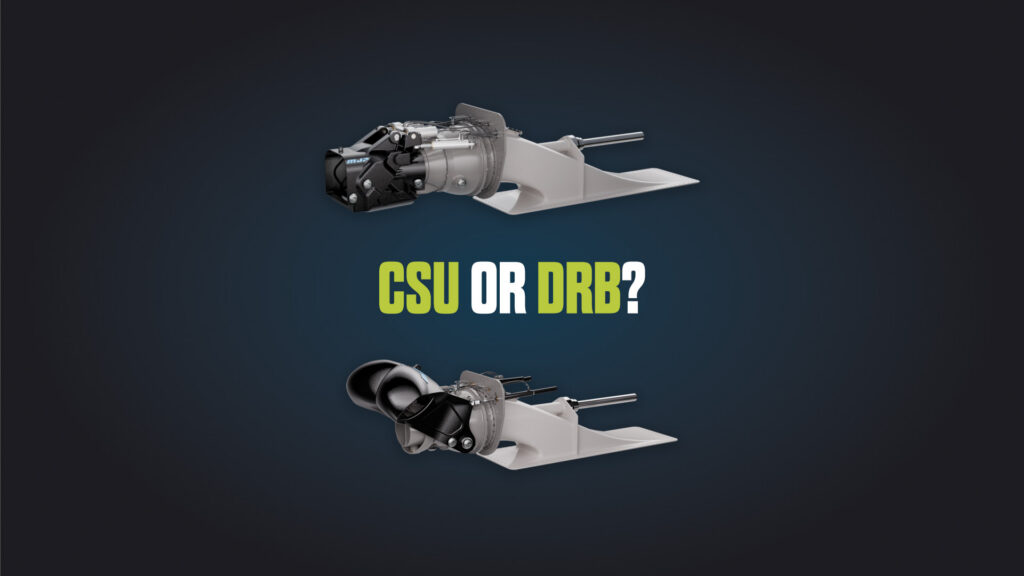
Choosing the right waterjet matters. The wrong choice can affect performance, fuel efficiency, and long-term reliability – so it’s worth understanding what sets each option apart.
MJP builds both mixed-flow and axial-flow waterjets and offers hybrid-electric options and high-efficiency retrofit solutions. This article focuses on two of the most widely used mixed-flow models: the DRB and the CSU, and how to determine which one fits your vessel and mission.
DRB – Built for Demanding Maneuverability
The Double Reversing Bucket (DRB) is MJP’s heavy-duty mixed-flow waterjet, designed for vessels where reversing performance and installation flexibility are priorities.
Its shared-duct reversing bucket supports strong maneuverability and fast reversing response. The pump is built with duplex stainless steel to handle challenging water conditions, including debris and sand. A key feature of the DRB design is that all hydraulics are housed inside the hull. This inboard arrangement reduces the risk of hydraulic oil spills, protects components from external damage, and gives shipbuilders more flexibility during installation.
DRB units cover an input power range of 1,250–6,000 kW and suit vessels from 26 to 200 meters. Earlier DRB configurations were typically wider and slightly heavier than comparable CSU models due to the inboard hydraulic arrangement. Recent design updates have reduced cylinder size and hydraulic tank volume, resulting in a more compact and weight-efficient solution while maintaining the benefits of protected inboard hydraulics.
CSU – Reliable Mixed-Flow Performance
The Compact Steering Unit (CSU) is MJP’s established mixed-flow waterjet for ferries, passenger vessels, governmental craft, and yachts. Like the DRB, it is designed for continuous operation, high efficiency, and reliable performance across a wide range of applications. Its compact configuration makes it particularly well suited to installations where space and vessel layout are key considerations.
Like the DRB, the CSU uses duplex stainless-steel construction. Its narrow reversing bucket design allows for closer center-to-center spacing on multi-jet vessels – an important advantage where installation space is limited. Intakes can be specified in composite, steel, or aluminum depending on hull requirements.
The CSU spans 2.5–24 MW and is designed for vessels from 26 to 200 meters. Because the reversing buckets are external, CSU units are generally lighter than DRB models. The external configuration may expose hydraulic cylinders to the marine environment, which is a factor to weigh against the installation benefits.
CSU waterjets are a proven choice for operators who value efficient installation, reliable operation, and precise vessel control across a wide range of operating conditions.
Choosing Between Them
The right waterjet depends on a combination of factors, including vessel size, mission profile, desired speed, and installation constraints. In general terms, the DRB is often selected when protected inboard hydraulics and reversing performance are key priorities. The CSU is frequently chosen for applications where installation flexibility, compactness, and efficient vessel integration are important considerations.
MJP’s Engineering & Advisory service and Jet Selector Tool can help match the right propulsion solution to your specific vessel and operational requirements. Whether the application is a patrol vessel, a large passenger ferry, or a specialized government craft, the goal is the same: reliable, efficient propulsion that performs when it’s needed most.