How MJP Supports Waterjet Installations with CFD
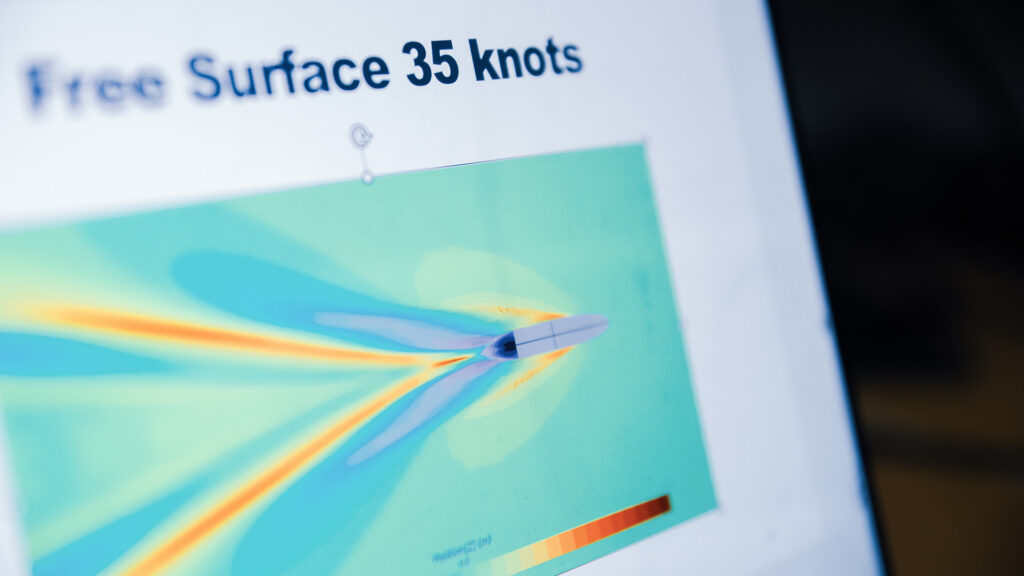
For a waterjet to perform as intended, the inflow needs to be as clean, even, and predictable as possible. Disturbed flow, air ingestion, pressure losses, or an intake that is not properly matched to the hull can affect efficiency, cavitation margins, steering forces, and overall vessel performance. This is why MJP uses computational fluid dynamics, commonly known as CFD, as an important engineering tool.
CFD is a simulation-based method used to analyze fluid flow. It helps us understand how water moves along the hull, into the intake, through the pump, and out through the jet. It can also be used to identify where air may be drawn into the system, how pressure changes inside a component, and what forces different parts are exposed to during operation.
“This allows us to visualize and analyze what is happening in and around the waterjet, even before the vessel is built. For our customers, that means better insight earlier in the project and a stronger basis for design decisions,” says Markus Norberg, Global Technical Sales Manager at MJP.
A Broader View
CFD became a practical engineering tool as simulation software advanced from the 1970s onwards. Earlier software had limited graphical interfaces and left more room for errors. Today’s tools are more advanced, more visual, and better integrated into the engineering workflow, making it a reliable method for evaluating complex waterjet installations.
This differs from conventional model testing, where you often need to decide in advance what should be measured. The result is typically a set of values from specific points or operating conditions. Model testing can also involve scaling challenges, especially in larger vessel projects where the behavior of a scaled model does not always translate directly to full-scale operation.
Instead of relying only on hand calculations or measurements from a limited number of points, CFD provides a broader view of the full flow field. It makes it possible to study the results from several angles and better understand how the flow behaves. It also delivers flexibility when evaluating different design alternatives and operating conditions.
Support for Shipyards, Designers, and Operators
Reliable CFD results rely on experienced engineers who understand which assumptions can be made, how the model should be built, and how the results should be interpreted. At MJP, our team combines specialized expertise with practical waterjet knowledge to support accurate and relevant assessments. The support is a part of our Engineering & Advisory services for both newbuilds and existing vessels.
“We help explain why the flow behaves the way it does, and what that means for the vessel, the intake, and the waterjet installation,” says Markus Norberg.
This can be particularly valuable for customized intakes, retrofit projects, or more complex vessel concepts such as podded solutions. For larger waterjet installations, where the intake is often customized to the vessel, MJP uses CFD to evaluate how the intake interacts with the hull and whether the flow conditions are suitable for the selected waterjet. The results are summarized in a technical report, giving shipyards, designers, and owners a clearer basis for decisions.
Interested in learning more about how MJP can support your next project through CFD? Learn more about our Engineering & Advisory services.